

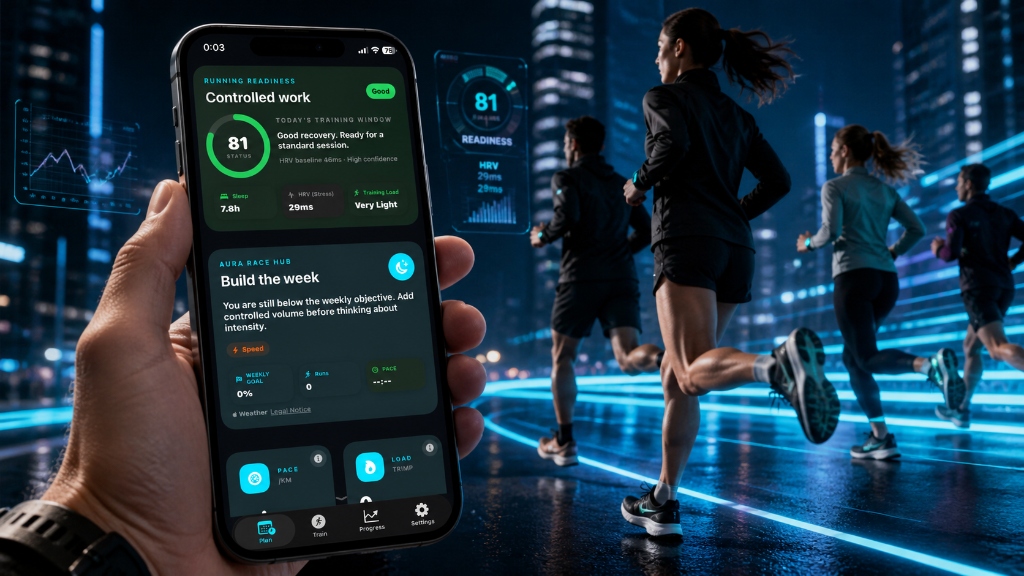
In professional athletics, the difference between a personal record and a stress injury is measured in milliseconds. The Aura Readiness Bio-Score is not a simple "rest" indicator; it is a precision tool based on the Banister Impulse-Response model, adapted for the Apple Watch era.
Each morning, when you wake up, your Apple Watch has captured thousands of data points while you slept. But the real value lies not in the raw data, but in the algorithmic interpretation. Aura Kinetic uses an analysis engine that separates biological "noise" from real signals of systemic fatigue. In this article, we break down the engineering behind your daily score.
1. The algorithm: 45% sleep, 35% HRV, 20% load
Unlike platforms that lean on a single metric, Aura weighs three independent signals, and none of them rules on its own:
- 45% · Sleep. Last night's hours, read from HealthKit. The curve rewards the 7.5–9 hour band and penalises deviation; oversleeping costs you too, considerably less than undersleeping. Without a watch, Aura uses your answer in the daily check-in, and never above the measured value.
- 35% · HRV, against your own baseline. There is no universal threshold: 40 ms can be excellent in one person and an alarm in another. Aura builds your baseline and reads each morning in standard deviations from it. The response is deliberately asymmetric: a drop weighs almost twice as much as an equivalent rise, because a collapse is a reliable stress signal and one high reading proves nothing. For the first three weeks, while the baseline forms, it blends with a population curve.
- 20% · Recent load. Computed with Banister's TRIMP, which weighs every minute by your heart rate reserve. Without heart rate, Aura degrades to running volume and, as a last resort, to steps.
Two further corrections then apply: your form — the TSB, comparing acute and chronic load — and your resting heart rate against your own baseline. A resting rate five beats above yours lowers the number even if you slept well.
What happens when a signal is missing: if the watch captures no HRV that night, Aura does not fill the gap. It redistributes the weight across what it does have and, above all, compresses the result towards the middle: with a single signal the number stays close to 60, on purpose. A readiness of 92 computed from one data point would be an opinion dressed up as a measurement.
2. The Science of Supercompensation
Training does not make you stronger; recovery from training makes you stronger. This process is called Supercompensation.
When you apply a stimulus (a run), your physical capacity temporarily drops. During rest, the body not only repairs what was damaged, but builds a little more in case the stress occurs again. If you train when your Readiness is at LOW (0-49), you interrupt this phase and enter a spiral of accumulated fatigue that leads to stagnation or injury.
Aura Kinetic seeks the "Sweet Spot": performing high-intensity sessions (intervals, threshold) only when your Readiness is at PEAK or GOOD. If the score is FAIR, the Training OS will automatically transform your session into a regenerative run (Zone 1-2) to facilitate the clearance of lactate and metabolic waste without adding extra stress.
3. Practical Cases and Common Mistakes
The effect of a late dinner
Many users are surprised to see a low Readiness after a heavy or late dinner. The reason is physiological: the body diverts resources to the digestive system, which raises resting heart rate and sinks HRV. Aura detects this and will warn you that your body spent the night "working" instead of "repairing."
Training with "Low" Readiness
Is it a sin to train in the red? Not necessarily if it is a planned overreaching phase. But doing it unplanned increases the risk of muscle fiber micro-tears by 40%. In these cases, Aura recommends replacing the run with muscle "flossing," mobility work, or total rest.
4. FAQ: Frequently Asked Questions
Why is my score different from the Apple Health app?
Apple gives raw data. Aura gives athletic interpretation. We apply load and trend filters that Apple does not consider for sports performance.
Should I blindly follow the Readiness?
Readiness is a compass, not a dictator. If you feel incredible but the score is low, listen to your body, but be aware that your internal systems might be more stressed than you superficially perceive.